


5 diamond painting accessories really worth buying — and 3 you don't need at all
- May 14
- 6 min read
By the time you have placed 200 drills on a new diamond painting project and it turns out that your pen keeps dropping beads, your diamonds are scattered in three open bags, and your eyes are getting tired of reading the symbols in the poor light, isn't that a specific kind of frustration?
The diamond painting accessories market has almost exploded with the hobby itself —and not every single one of them is worth your money. Some of the tools really change the whole experience. Others are just products that are cleverly marketed and then end up on the dust collectors' list after only one use. The difficult part is figuring out which is which before you have already spent your money.
That's why here is a really straight, no-nonsense explanation. Five items are generally seen as very worthwhile by the most experienced crafters - and three items are very often recommended but can without a doubt be skipped from the point when you are a beginner.
5 Diamond Painting Accessories to Add to Your Kit
1. High-Quality Light Pad — Give Your Eyes a Break
Working with a light pad is like having a backlit canvas, as it shines light through the fabric and shows the symbols very clearly. Thanks to this, you can see each symbol distinctly, it is easier to differentiate the colors, and you barely realize that your eyes are getting tired - something that usually happens when you work for hours without a break.
Most beginners don't even think about this as one of the main reasons why the projects end up being abandoned halfway through. This is especially true for large 5D diamond painting canvases. Those with dense symbol layouts are often a culprit. Research into the effects of doing craft work at very close range has shown a direct link between poor lighting and headaches, fatigue, and loss of concentration.
It is very likely that the light pad you purchase from Amazon India will be either an A3 or A4 size and will be powered by LED. It will also likely be in the range of ₹800–₹2,500. The ability to adjust the brightness level of the light pad is the feature that most people consider worth spending extra money on. One level of brightness is rarely enough - lighter canvases need less light whereas ones that are darker require more, and working at night is different, as less light is needed to avoid glare.
2. A Multi-Placer Pen — The Upgrade That Actually Saves Time
Most diamond painting kits only include a single-drill pen, which is sufficient to accomplish the task. However, it becomes very monotonous for someone who has done tons of large-colour-blocks — like a sky, a background or a solid border — since a single-drill pen allows for the placement of only one drill at a time.
A multi-placer diamond painting pen can pick up 3, 6, or even 9 drills at the same time, which is a major time saving for completing large areas. This is supported by the data shared by several diamond art groups, which indicate a time reduction of 40–60%. This is a substantial difference for a 50×70 cm canvas.
Now, it should be understood that a multi-placer is not intended to substitute your single-tip pen totally. It is supposed to be used with it. Detailed sections and confetti areas (where colours change every few drills) still call for single-tip precision. But for large fill sections, a multi-placer is genuinely one of the top diamond painting tools that you can include in your kit.
Ergonomic grip design is very important here. Crafters' hands can become very tired from holding a poorly designed pen, especially since sessions frequently last for an hour or more. In fact, many crafters only realize this after they have switched to a better pen.
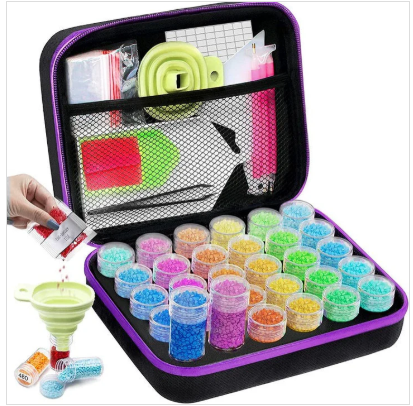
3. A Labelled Storage System — Because Mixed Diamonds Are a Nightmare
This might sound like an unremarkable suggestion. However, if you ask someone who has accidentally overturned a tray of unsorted diamonds during work and then had to separate DMC colour codes by sight for an hour,
they will tell you that the labelled storage system is a gift they cannot live without.
Most seasoned diamond painters agree that transparent screw-top containers with DMC number labels are the ideal way to store diamonds. Besides these containers, small pill organisers, bead storage boxes, or exclusive diamond painting organiser kits (which are readily available on Amazon.in and Flipkart and range from ₹300 to ₹1,200) are excellent alternatives.
The key aspect is being able to identify the colour instantly without having to open the container.
Adding a silicon funnel to the list of small tools is worth it as it helps in refilling the containers with leftover diamonds in a clean and quick manner. It is often a part of organiser kits and is really good to have.
4. A Roller or Brayer — The Finishing Touch That Locks Everything In
Rollers for diamond painting (also sometimes called brayers) are very simple tools. Essentially, they make the job of firmly pressing the drills into the adhesive much easier by spreading a gentle and even pressure over the finished canvas. This tool comes in handy after finishing a partial or entire canvas.
A big disadvantage of not using a roller is that diamonds may move around, become loose or even stand slightly off the surface, especially in the large section areas' edges. Rolling very briefly after completing each area of your diamond painting will greatly diminish the chance of diamonds becoming loose later on - especially if the canvas is going to be framed or placed at a location where there is movement or vibration.
Here is the tip from the pros that is really worth sharing: you should never roll the canvas directly. First of all, a soft cloth, a sheet of butter paper or a thin tea towel may be used. If contact is made without any barrier, your diamonds' facets may be scratched and the shine that you have painstakingly created may be dulled.
Rollers do not cost a lot - most can be bought for ₹150–₹500 - and the difference in the lifespan of a finished piece is quite remarkable.
5. A Release Paper Cover — The Uncelebrated Star of Diamond Painting Materials
Release paper is a very thin and flexible sheet of protective layer that is placed over the parts of the canvas that an artist is not working on at the moment. The primary function of the release paper is to protect the adhesive from different types of contaminants such as dust, pet hair, and human touches, etc. all of which can reduce the stickiness of the canvas even before the artist is able to place the drills on it.
Typically, the kit comes with a small release paper sheet, but it's hardly sufficient for bigger works. Purchasing an extra roll of wax or release paper is among the cheapest and most beneficial upgrades one can make. A canvas that becomes less sticky halfway through the project is one of the top diamond painting nuisances — and almost totally avoidable by following this single simple step.
3 Diamond Painting Accessories You Do Not Need
Electric Vacuum Pen: Just a Fancy Toy
Electric diamond painting accessories pens rely on battery-powered suction to pick up drills. The marketing states that they are the most handy tool, however, in reality, they have been considered hard to master, regularly grabbing the wrong drill and barely appropriate for the surface other than flat, wide areas. The majority of those who buy a diamond pen revert to the wax-tip pen after a few tries.
Better to spend the money that you would have used for an electric pen on a storage system or light pad.
Expensive Wax Pots — The Classic Is Still the Best
Specialty waxes in fancy tins and "premium formula" wax pads are often pushed as the new standard market evolution. Actually? The simple pink wax block included in almost every diamond painting kit works equally well in picking up the drills. Wax is wax. As soon as your pen's tip is gently coated, it can pick up a drill without fail — changing the wax brand will not affect this.
A Dedicated Diamond Painting Workstation — Not for Beginners
These are desks or boards that are Adjustable with built-in compartments, slanting surfaces, and lights. They exist, and serious hobbyists even It's wear. But at ₹4,000–₹12,000, they're a major investment that most beginners certainly don't need. A regular table, your light pad, and a storage organizer accomplish the same work for dramatically less money. If you end up doing three or four big projects a year, then It's time you think about it. Meanwhile, just give it a miss.
The Bottom Line
Diamond painting is a gratifying, mentally calming craft, but having the right diamond art tools can definitely smooth, speed up, and enhance the whole experience.
The best ones to buy aren't necessarily the costliest or the ones most heavily advertised. They're the ones that address a real problem you are likely to face at the table.
Initially get a light pad, a multi-placer pen, and a good storage system.
Then purchase a roller and some extra release paper. That gives you a complete, practical diamond painting supplies kit that includes every step of a project from setup to finishing.
Don't buy anything beyond that until you understand what frustrates you the most in your diamond painting process.

Comments